


ispace and Chuo University reach agreement on collaboration to transport small AI robots used in future lunar lava tube exploration missions to the Moon
2025.3.7
ispace, inc. and Chuo University have concluded a memorandum of understanding regarding technical studies for transporting small AI robot swarms to the Moon as part of the Moonshot Kunii Project.
You can check the full text of the announcement in the following PDF file.
ispace and Chuo University reach agreement on collaboration to transport small AI robots used in future lunar lava tube exploration missions to the Moon
* This announcement is a joint press release from ispace, inc. and Chuo University.
ispace, inc. (Chuo-ku, Tokyo; Founder & CEO: Takeshi Hakamada; Securities Code: 9348; “ispace”) and Chuo University (Hachioji-shi, Tokyo; Chief Executive Director: Masahiko Omura) jointly announced today that they have concluded a memorandum of understanding (“MoU”) to study the technical feasibility of transporting small AI robots to the Moon. This endeavor is part of the Cabinet Office Moonshot Research and Development Program project to develop “evolvable swarm robots that can share intelligence to settle in unknown and unexplored areas,” which is led by Professor Yasuharu Kunii of Chuo University’s Faculty of Science and Engineering as project manager.
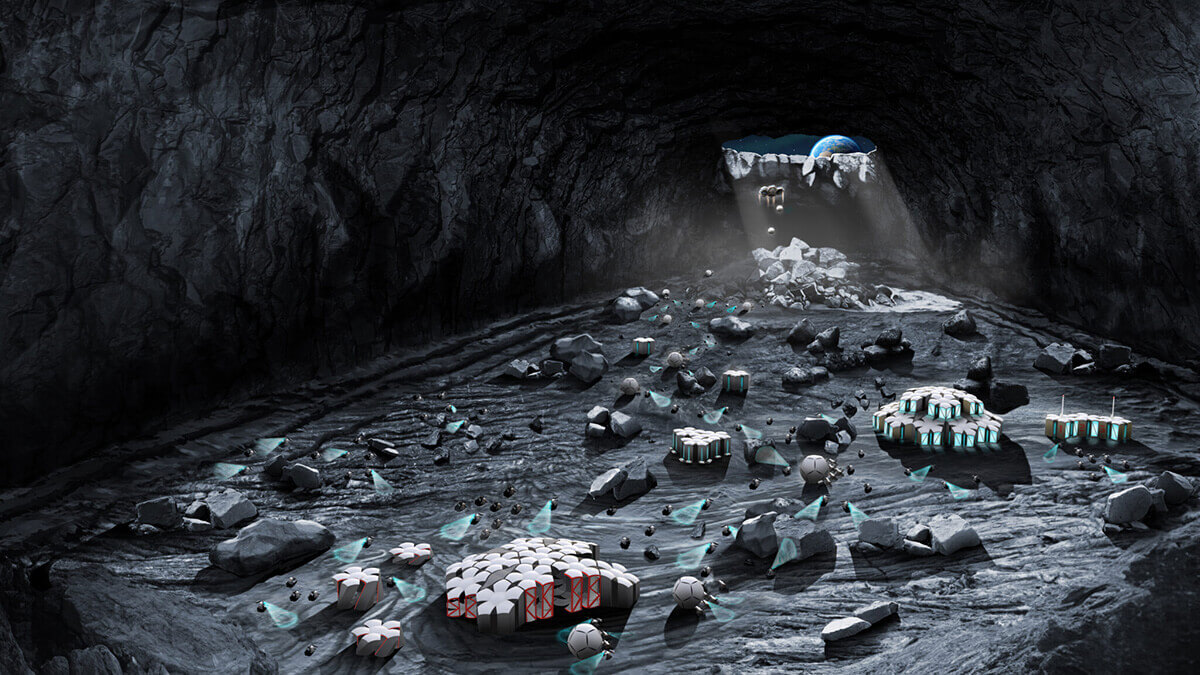
Computer-generated image of an exploration base expected to be constructed within lunar lava tubes around 2050 through advancement of the initiative. A large number of small AI robots act cooperatively to conduct exploration, transportation and settlement across a wide area
Under the MoU, ispace and Chuo University have agreed on a collaborative framework to transport the small AI robots developed by the Chuo University Kunii Moonshot Project and realize the exploration of lunar lava tubes across multiple missions from 2028 onwards.
The Cabinet Office Moonshot Research and Development Project is a Cabinet Office policy initiative to advance research and development based on bold ideas that go beyond the extension of conventional technology, with the aim of creating disruptive innovation originating in Japan. The Kunii Moonshot Project at Chuo University is conducting research and development toward goal 3 of this program, “By 2050, realize robots that can learn and act on their own and coexist with humans through the co-evolution of AI and robots.” This involves the formation of swarms of small robots with simple functions that demonstrate collective network intelligence, and the research and development of a system in which the entire group evolves through the updating and expansion of common functions and the addition of new robots.
Lunar lava tubes were discovered by the Japanese lunar orbiter Kaguya, and are thought to have been formed by lava flows beneath the surface of the Moon. Because the temperature inside lava tubes changes little and the risk of radiation and meteorites can be reduced, it is expected that they will serve as strong candidates for the sites of construction of future manned exploration bases.
Through research and development by the Kunii Moonshot Project at Chuo University, a swarm of low-function small robots will be automatically organized and controlled by advanced strategic intelligence (network intelligence) installed in each robot, enabling them to explore the inside of lunar lava tubes, survey habitable areas, and transport spherical robot containers. In addition, missions inside the side holes of lunar lava tubes will be carried out to obtain information necessary for subsequent research and development. It is expected that based on this research, full-scale lunar city development phase may begin.
ispace is leveraging the regional culture and diversity of its three business units in Japan, the U.S. and Europe to advance space development as a single integrated global company. On January 15, 2025, Mission 2 led by ispace Japan successfully launched, and plans to reattempt a moon landing as early as June 6, 2025. Next, Mission 3 led by ispace U.S. is planned for 2026. Then in 2027, Mission 4 (originally Mission 6) plans to utilize the Series 3 Lander (tentatively named) currently being developed in Japan. To meet the growing demand from governments, companies and educational institutions around the world, ispace will provide payload service agreements and data services as part of Mission 3 and subsequent missions.
Comment from ispace Founder & CEO Takeshi Hakamada
“The signing of this memorandum is a new example of ispace providing opportunities for technology demonstrations on the Moon as part of the Japanese government’s Cabinet Office Moonshot Research and Development Program. As part of our business model, ispace will support pioneering projects by providing transportation services to landing sites that meet the needs of our customers.”
Comment from Chuo University President Hisashi Kawai
“With the signing of this memorandum of understanding and the start of collaboration between the Chuo University and ispace as part of the university’s research project aiming to explore lunar lava tubes, I feel that the space age is drawing closer. I am delighted that the research and development of Chuo University will lead the space age and become the driving force for opening up the future. With the Chuo University Research and Development Initiative of which this project is a part serving in a core role, we will further advance ambitious research through collaboration between industry, academia and government.”
Comment from Professor YasuharuKunii, Faculty of Science and Engineering, Chuo University
“The synergy between our Moonshot team’s AI and robot exploration mission technology and ispace’stransportation technology will create the next Japanese and world firsts in Japan’s space exploration technology. I am confident that by shedding light on the future potential of using difficult environments, such as the underground space in the moon, we can grasp the future of humanity and contribute to the expansion of our knowledge and humanosphere.”
About Chuo University (https://www.chuo-u.ac.jp/)
Since its founding in 1885, Chuo University has adhered to its founding philosophy of “fostering the ability to apply knowledge to practice” and continued to pursue education and research that addresses real-world issues through its mission of supporting society throughout the ages and pioneering the future. Based on Chuo Vision 2025, Chuo University aims to build a sustainable society and cultivate next-generation talent with the ability to take action in ways that contribute to the international community, and is advancing plans to establish five new faculties from 2026 to 2017.
About ispace (https://ispace-inc.com/jpn/)
ispace is a space industry start-up company that is working toward the development of lunar resources. Its vision for the future is expressed by its slogan, “Expand our planet. Expand our future.” The company has business entities in Japan, Luxembourg, and the United States, with approximately 300 employees worldwide. Established in 2010, ispace operated HAKUTO, one of the five finalist teams in the Google Lunar XPRIZE race. ispace specializes in the development of small lunar landers and lunar exploration rovers with the aim of providing high-frequency, low-cost transportation services to the Moon. ispace is also launching the Lunar Data Business Concept to support their entry into the lunar market, with the aim of becoming a gateway for private companies to do business on the moon.
The company’s first Mission 1 lander successfully lifted off aboard a Falcon 9 rocket operated by SpaceX on December 11, 2022. This was followed by Mission 2 which successfully launched on January 15, 2025. Mission 3 and Mission 4 (formerly Mission 6) are scheduled for launches in 2026i and 2027ii respectively.
The aim of Mission 1 is to verify lander design and technologies, and to verify and strengthen business models for providing lunar transportation services and lunar data services. Of the 10 milestones, ispace has reached Success8, and in the source of the current Success9 milestone, has succeeded in obtaining valuable data and know-how for achieving a lunar landing mission, including data during the landing sequence.
The data and know-how obtained during Mission 1 will be utilized in the subsequent Mission 2.
Additionally in Mission 3, ispace also plans to contribute to NASA’s Artemis mission by providing more accurate lunar transportation services.
i Assumption as of March 2025
ii Assumption as of March 2025